
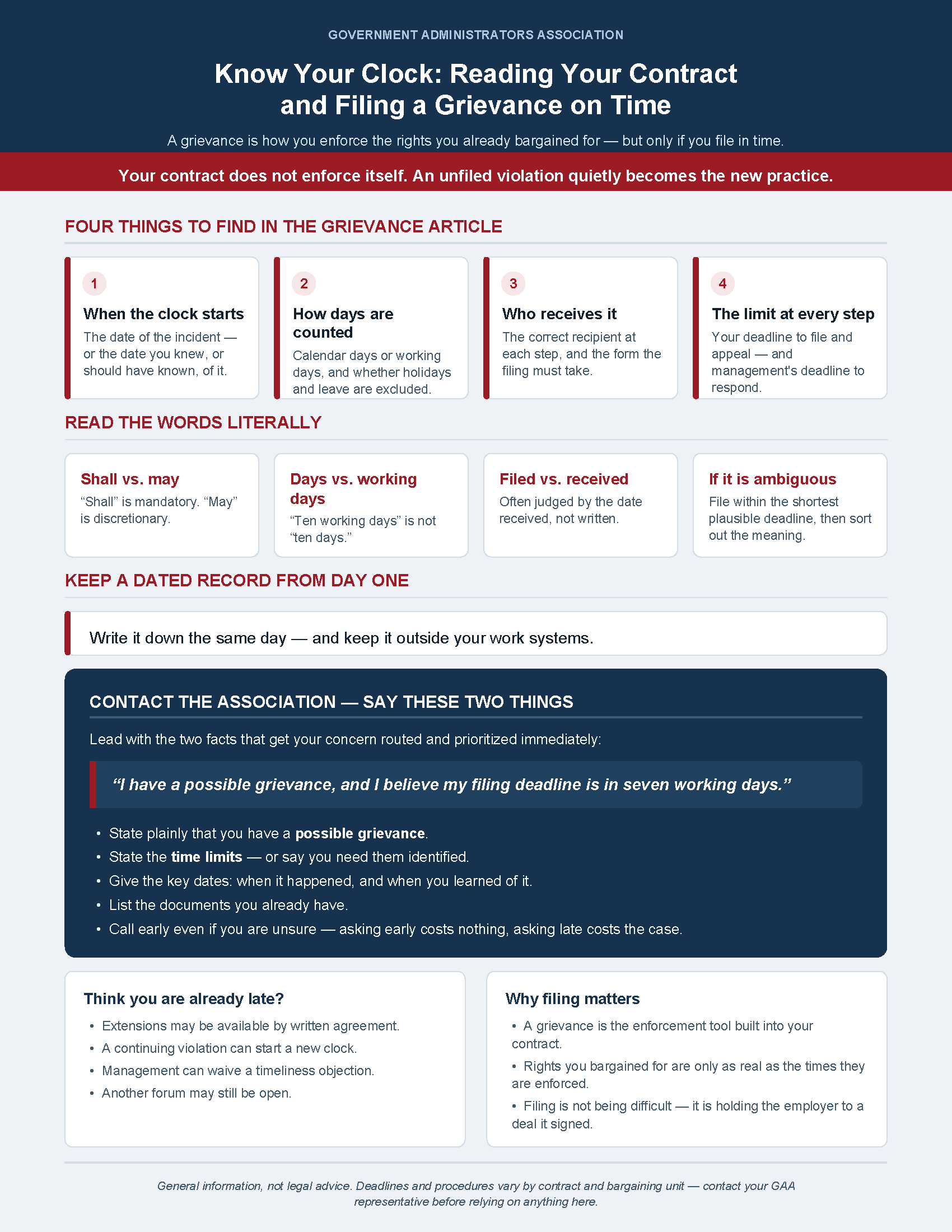
A grievance is how you enforce the rights you already bargained for, but only if you file in time.
A Grievance Is Enforcement, Not Complaint
Your collective bargaining agreement is a set of rights you already won. A grievance is simply the mechanism that makes those rights real, the enforcement tool built into the contract itself. Nothing in the agreement enforces itself. When a provision is violated and no one files, the violation quietly becomes the new practice. Filing is not being difficult; it is holding the employer to a deal it signed.
The Deadline Comes Before the Merits
Your contract gives you a strict window, often just days, between the violation and the moment your written grievance must be in the employer’s hands. Miss it and management can reject the grievance as untimely, and arbitrators routinely uphold that regardless of how strong your case was. Establish the deadline first, before you spend an hour on evidence or argument.
What to Read in the Grievance Article
Open your agreement to the grievance and arbitration article and pin down these points:
If you do not have a copy of your collective bargaining agreement, contact the Association to request one.
- When the clock starts: the date of the incident, or the date you knew or should have known of it.
- How days are counted: calendar or working days, and whether holidays and leave are excluded.
- The time limit at each step, for your filing and for management’s response.
- Who must receive the grievance at each step, and in what form.
- Whether extensions are allowed, and whether they must be in writing.
- What happens if management misses its own deadline. Some contracts advance the grievance automatically.
Read the Words Literally
‘Shall’ is mandatory; ‘may’ is discretionary. ‘Ten working days’ is not ‘ten days.’ A grievance that must be ‘filed’ is often judged by the date received, not the date written. If two provisions conflict or the language is ambiguous, do not resolve it yourself. File within the shortest plausible deadline and sort out interpretation afterward.
Common Ways Members Lose the Clock
Most untimely grievances come down to the same few mistakes:
- Waiting on an informal conversation with a supervisor while the window runs out.
- Counting calendar days when the contract says working days, or the reverse.
- Verbal complaints with no written record and no date.
Keep a Dated Record from Day One
Write down what happened, when, and who was present the same day it occurs. Save every notice, email, and schedule with its date intact, and keep the record somewhere outside your work systems.
Contact the Association, and Say These Two Things
When you reach out, lead with the two facts that get your concern routed and prioritized immediately: say that you have a possible grievance, and state the time limits you are working against. A message that opens with ‘I may have a grievance and I believe my filing deadline is in seven working days’ moves to the top of the queue. A message that only describes a problem may sit in the ordinary flow of correspondence while your clock runs.
- State plainly: ‘I have a possible grievance.’
- Give the key dates: when it happened and when you learned of it.
- State the deadline as you understand it, or say that you do not know it and need it identified.
- Attach or list the documents you already have.
- Call early even if you are unsure you have a grievance. Asking early costs nothing; asking late costs the case.
If You Think You Are Already Late
Bring it forward anyway. Extensions may be available by written agreement, continuing violations can start a new clock, management can waive a timeliness objection, and another forum may still be open. Never decide on your own that it is too late.
This article is general information, not legal advice. Deadlines and procedures vary by contract and bargaining unit. Contact your GAA representative before relying on anything here.